Meat
Primal meat processing is conducted in large halls with hundreds of workers in proximity. The duty of care towards both employees and customers is at the forefront of corporate and public concern. Round-the-clock shifts make sanitation even more of a challenge and increase the importance of hygienically designed belts that ensure fast and effective deep sanitation. Volta homogeneous belts answer all the stringent requirements of modern processing.
Stages of production
Primary breakdown/evisceration
Depending on size, carcasses are handled whole or halved. Once the joints are of a manageable size, they will be transferred to heavy duty conveyors requiring resistance to impact.
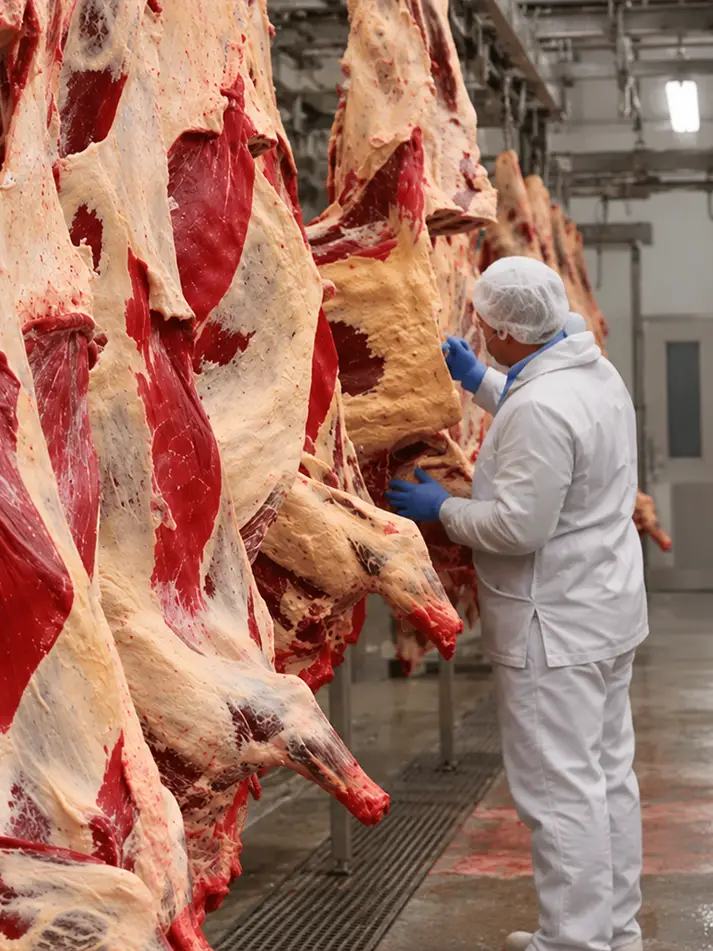
Primal cutting
This involves labor-intensive knife work around stations, either side of long conveyors is the norm. Belt hygiene is important where many locations work shifts around the clock and require fast and effective sanitation.
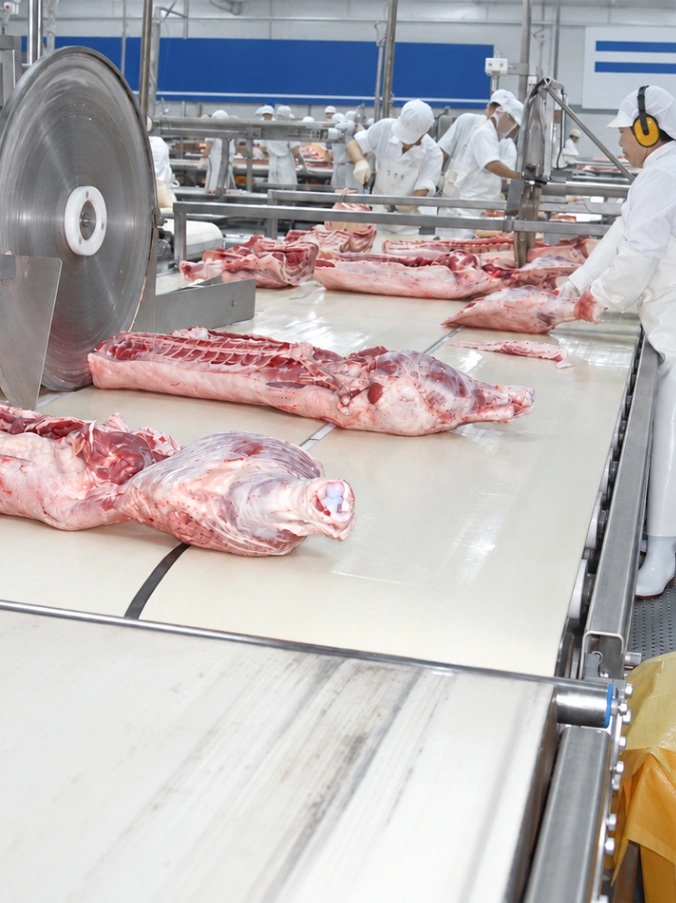
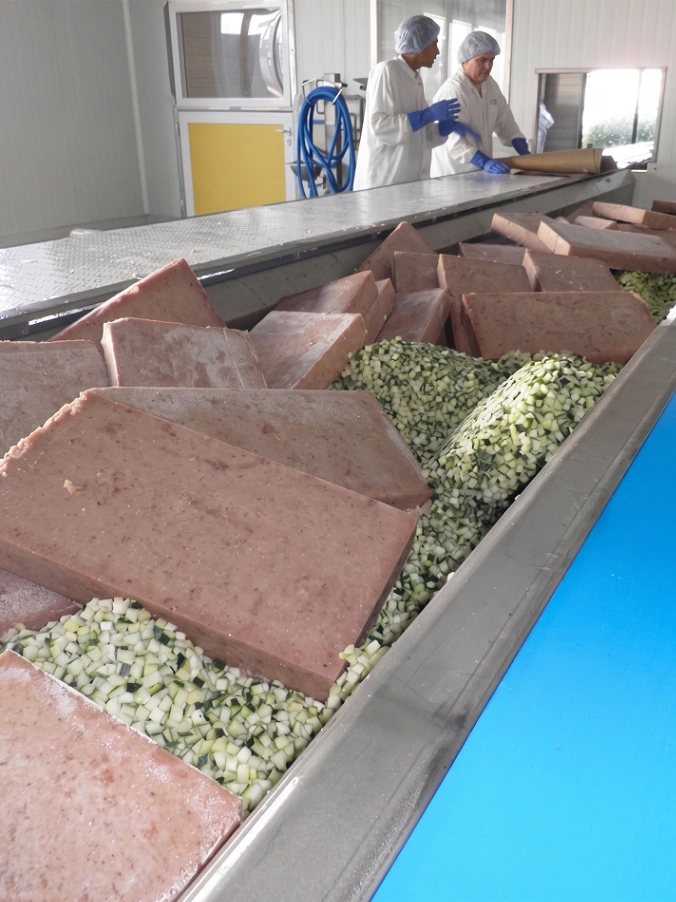
Trimming and subprimal cutting/frozen blocks
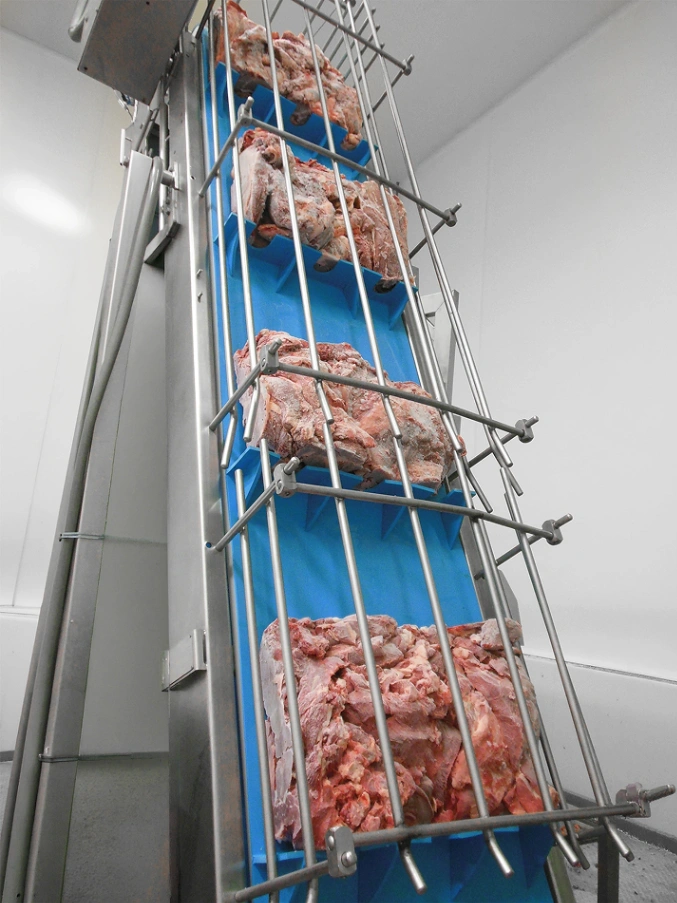
After this, the joints are broken down in butchers’ cuts suitable for marketing directly and commonly in a chilled, not frozen state. Excess material including fat, bones and unshaped meat residue is trimmed off and may be fed to separators or waste lines. Alternatively, offcuts with good potential for patties and other secondary products may be amalgamated into convenient frozen blocks for processing elsewhere. Handling these blocks, especially on elevators, is a key challenge.
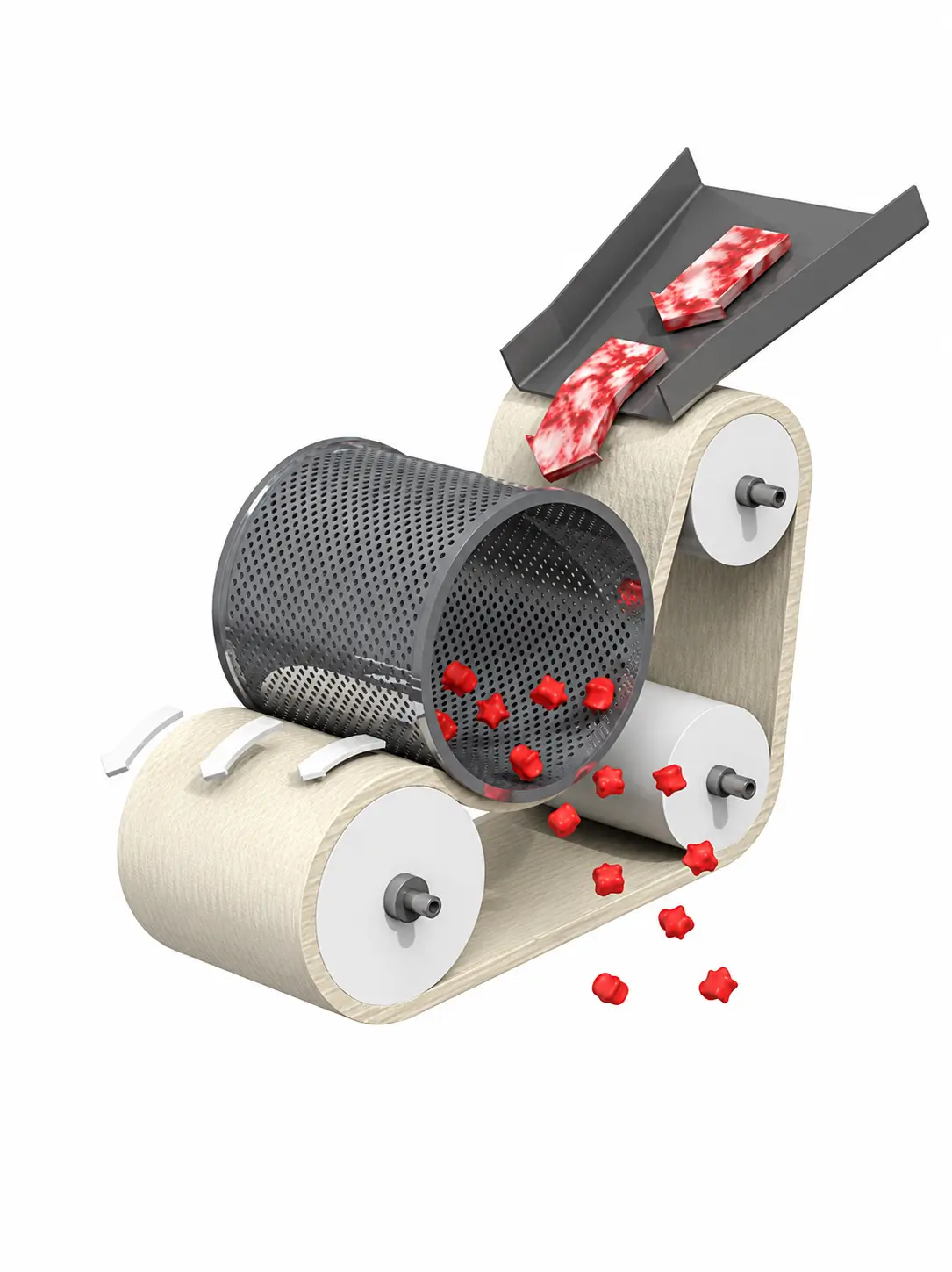
Separators
Belt separators recover significant quantities of high-quality protein for small goods and cold cuts, sometimes preserved in frozen form for admixing.
Offal / Organs
Offal is a valuable by-product but organ sets are separated on specially configured belts immediately after evisceration until the meat is confirmed as fit for consumption. Hermetic compartments permit this without cross-contamination.
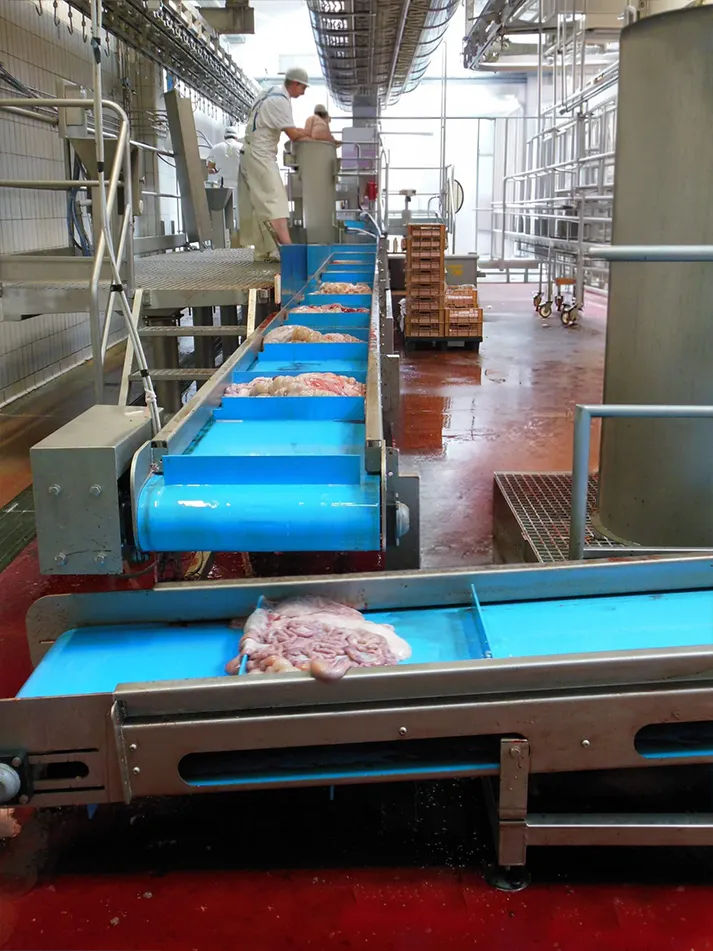
Processing – Mince / Sausages / Skewers / Patties / Cold Cuts
Trimmings and other sections of meat not processed for joints are converted on secondary lines to a variety of products: mince, sausages, cold cuts, skewers, and patties. Many of these processes are automated and require defined belt typologies to fit machines. Volta works closely with leading OEMs to provide hygienic belts for slicing, and other key parts of these processes.
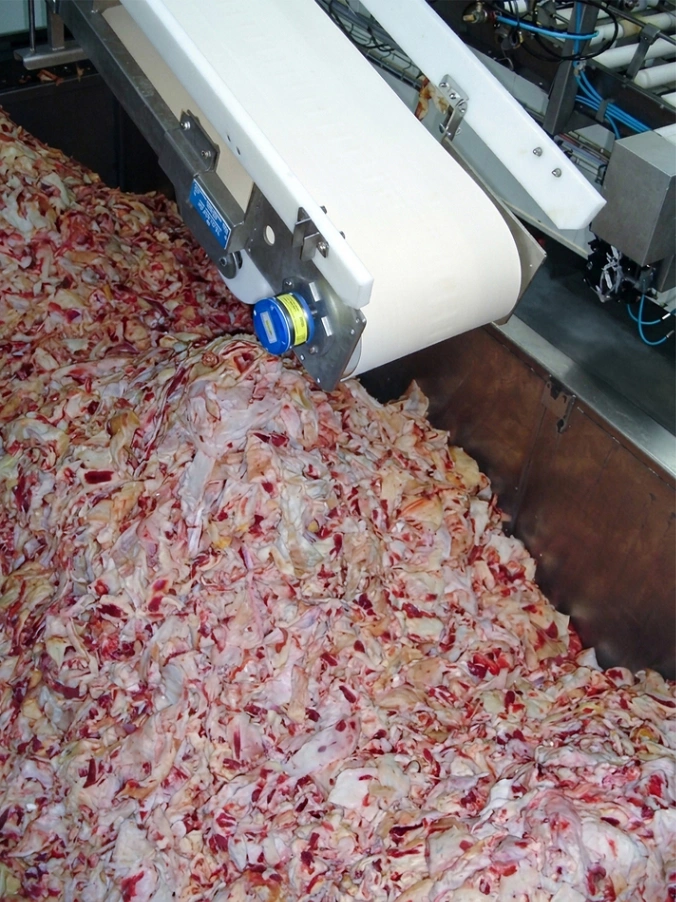
Waste Handling – Bones / Fat
Waste handling of, for example, bones, and fat requires hygienic belts as most of these materials are generated in and transported away from high risk, food processing zones.
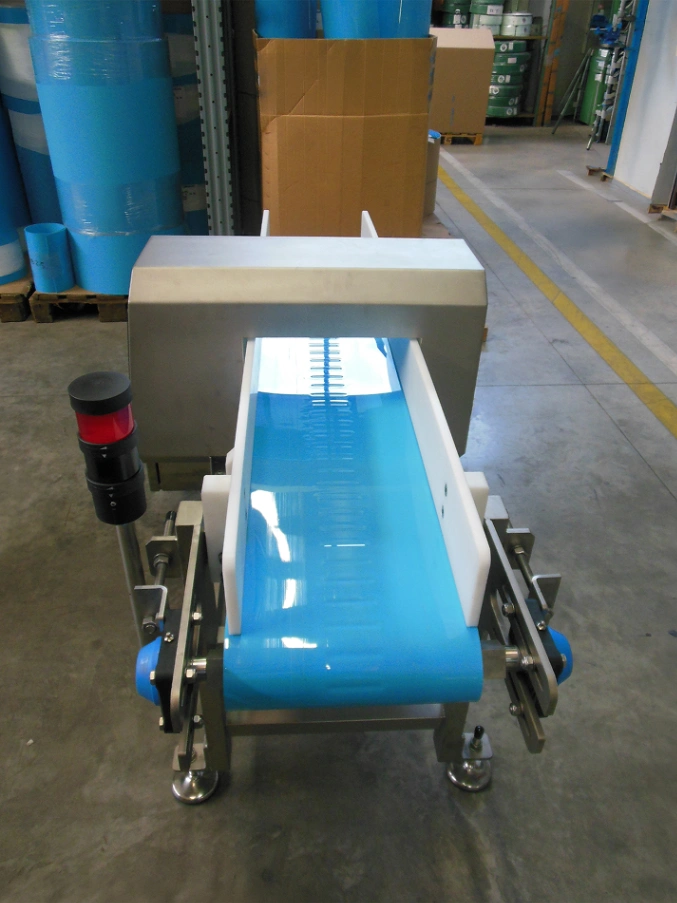
Metal / X ray detection
Metal and X-ray detectors are used at multiple stages in meat processing. Volta belts enable reduced disinfection procedures thereby reducing the risk of interference with the calibration and accuracy of the detectors.
Volta’s homogeneous belts comply with EU, FDA and USDA regulations and can handle product regardless of size, weight, shape and consistency, this includes frozen blocks and raw materials with sharp fragments.
Volta’s solid, impervious TPE belt will not absorb fats, liquids, and chemicals, or harbor harmful bacteria such as Salmonella or E. coli, which are major challenges for the pet food industry.
Volta’s solid TPE belts are highly cut -resistant and can be installed easily onsite.
Volta’s belts offer a wide range of temperature resistance, from frozen to warm.
Retrofit from competitor’s thermoplastic belt
Volta’s decades of field experience have contributed to the successful development of highly resistant belt formulations. A case in point can be seen here with the replacement of a generic 1” pitch thermoplastic belt which could not withstand the load in this meatworks and elongated and then off tracked after about 8 months of use. Volta’s field team performed some calculations and decided that the application could suit a mini pitch thermoplastic belt, thus avoiding a refit to a larger gauge which would have required adaptations on the conveyor and with the motor. A Volta Mini Dual Drive™ belt was fitted with a neat and hygienic tracking element and during nearly 5 years of service, the factory also reported better cleanability.

Retrofit meat blocks elevator
A major producer of meat patties employed a modular belt for the almost vertical elevation of 25kg frozen blocks into a grinder. Blocks were loaded manually with the belt suffering damage from even a slight mistiming, breaking the brittle cleats when blocks were pushed on top of them. Plastic fragments were routinely ground along with the meat. This exposed the production line to the risk of foreign bodies and of pathogenic biofilm from belt parts exposed to daily contact with meat. The cleats were also rendered less efficient and frequent maintenance was necessary in a processing area with difficult access. Volta’s partners commissioned the sturdy but flexible cleat with four gussets welded on for a perfect result on a 3mm thick base belt which thus conformed to the existing conveyor design.

Built to Meet the Highest Food Safety Standards
Our highly durable, moisture resistant belts comply with the strict hygiene requirements of the food industry, EU No.-10/2011, 1935/2004, 2023/2006 and relevant amendments. Complies with the Requirements of Code of Federal Regulations (CFR21) USDA FDA article 21 CFR 177.2600. Supports the HACCP concept.

FAQ’s
To which regulations must a conveyor belt conform to for meat and poultry processing? (FDA, EU 1935/2004)
Belts need to be food certified by the relevant agency that governs local/national production, and the plant will be audited by an organization accepted by their customers. Volta belts are certified for direct contact with meat, poultry and their by-products and are quickly recognized and approved by auditors during their review work. Volta material is highly cleanable and maintaining this qualitative edge is a duty carried out by the correct design and implementation of QA validation protocols.
Which belt material is right for raw meat vs. processed meat?
Substantial sections and joints of raw meat are prepacked for consumer markets. The bug counts on these materials, even where they are under permitted levels, helps determine shelf life so using a Volta belt that stays cleaner and resists bacterial build-up protects consumers and lowers the risks of recalls.
Improved shelf life is of course relevant to processed meat with the additional challenge that some products, for example sliced cooked meats, are often eaten out of the packaging “as is”. More stringent standards known as “high care” then apply, making the continual hygienic condition of all states of production and packing, crucial. Volta materials are ideally suited to this challenge.
Homogeneous or modular belting for meat plants?
When used judiciously, homogeneous belts require approximately 55% less water, manpower and time to clean to a usable standard. Add to this an additional saving arising from the belt not allowing fats, blood and food particles to fall through into the conveyor, and the homogeneous belt can be seen to have a clear advantage in terms of lower cost of ownership over time. A study at a beef processor in France, calculated belt costs at about 0.5 Eurocents per 1000kg of processed beef – several times lower than modular systems.
Can the belt handle frozen blocks and sub-zero lines (IQF)?
Volta has designed belts to elevate frozen blocks up to 40kg in weight; 25kg standard blocks are commonplace. Cleats will not break and there is thus no danger of foreign bodies in the product (frozen blocks are often fed into grinders). Volta materials work in deep subzero ambients but are not suited to IQF freezers as they cannot be perforated sufficiently to cope with the required circulation of frozen air.
Can Volta belts be cleaned in place, and will they off-track during a high-pressure washdown?
Volta material can be cleaned in place, but this can be performed with standard equipment at the end of a shift. Some conveyors may have a built-in CIP system. These are usually located inside the belt path and can raise hygienic issues of their own, further complicating sanitation being difficult to clean. When used on a homogeneous belt, only the underside of a belt will be cleaned. When used in conjunction with a modular belt the pressurized water will tend to cause a potentially pathogen-ridden aerosol that can disperse over adjacent workers, conveyors and other surfaces. Although compatible in theory, the use of an online CIP system with homogeneous belts may not be justified.
Can belt fragments reach the product? (foreign-body risk — a top food-safety concern)
As noted in the question regarding frozen block handling, Volta materials do not fracture on impact from heavy blocks and rarely shed particles large enough to constitute a foreign body – this is in sharp contrast to modular belts. Volta has replaced other belts, modular and ply, on beef boning lines in Australia, handling thigh bones weighing more than 25kg with no resulting foreign bodies. The weekly replacement of modular sections that were shattered by impact was also eliminated.
How does it resist blood, fats, oils and knife cuts?
Volta’s materials are generally oil, blood and fat resistant. Several belt types display excellent hydrolytic properties so that harsh chemicals used to clean biofilm do not degrade the belts. Volta’s belting has a highly dense molecular structure that is impervious to these materials. Knife cuts, where heavy cutting is performed directly on the belt, are sometimes noticed but as a rule, the material remains cleanable throughout its working lifespan.
What's the real lifetime cost vs. a cheaper belt?
Over the years, Volta has been involved in both controlled tests and monitored via collected data from processing plants. An independent test performed at a certified laboratory clearly gave 55% savings on the belt alone. As noted previously, there is an additional saving in real life situations as, for example, a modular belt will also cause widespread contamination of the conveyor, resulting in far more cleaning (potentially this can mean an additional 20% cleaning and downtime). Costs of labor, water, chemicals and manpower vary from country to country, but these are rising globally and paying for water treatment or wastewater disposal adds to the bill of running a factory. This in turn makes each and every saving that Volta’s materials offer more significant.
Saving downtime during sanitation and maintenance is invaluable in factories working shifts where production time may be gained. Some factories will pay extra for deliveries of belts or replacement parts due to their remote location. Add to this installation fees charged by contractors or the work performed by expensive maintenance teams. The reduction in maintenance, downtime and cleaning costs, plus the relative longevity of Volta materials, makes the purchase of cheaper belts or alternative plastic belt types increasingly questionable. Where belts are unusually cheap, care should be taken to confirm they are truly food certified and, in any event, they are likely to be poorly finished and thus harbor dangerous pathogens. Cheap is usually a false economy.
Volta has the widest experience of any producer in the implementation of homogeneous food processing belts and has argued the case for hygienic belts for decades. The 2016 EHEDG Guideline 43 recognized the unique value of homogeneous material as appropriate for hygienically designed belts, in sharp contrast to other plastic belt types.
Volta also has the widest technical experience in applying these materials on new conveyors and refitting existing processing rooms to upgrade hygiene and save costs at one and the same time.