Home » Industries » Food & Hygiene » Pet Food
Pet Food
In pet food manufacturing, contamination control, odor management, and sanitation downtime, all affect product quality and line efficiency. Volta’s homogeneous belt solutions are designed for demanding wet and dry pet food applications where processors need durable, easy-to-clean conveyor belts that perform reliably around fats, moisture, abrasion, and impact.
Excepting ingredients, the general manufacturing process for pet food mirrors that for making processed food for human consumption. Many of same regulations apply to manufacturing wet pet food products packaged in cans, bags and trays.
Volta’s homogeneous belts comply with EU, FDA and USDA regulations and can handle product regardless of size, weight, shape and consistency, this includes frozen blocks and raw materials with sharp fragments.
Volta’s solid, impervious TPE belt will not absorb fats, liquids, and chemicals, or harbor harmful bacteria such as Salmonella or E. coli, which are major challenges for the pet food industry.
The belts’ resistance to bacterial contamination and their easy to clean surface minimizes belt odor and reduces cleaning downtime and waste management while increasing production time.
Handling of fresh or frozen blocks
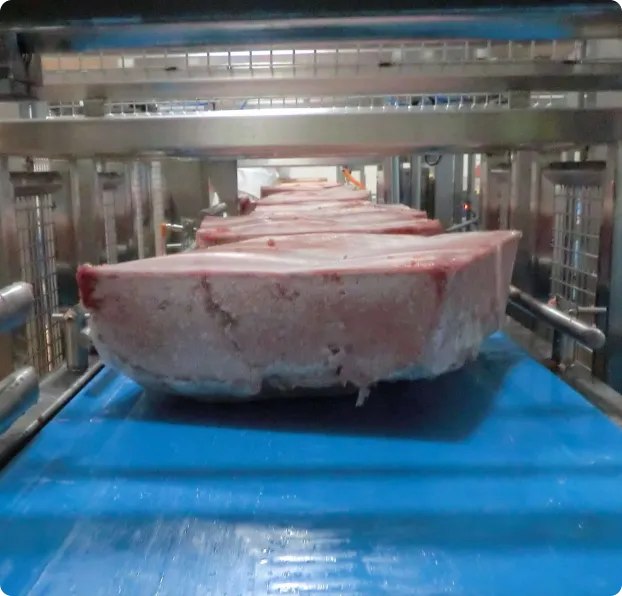
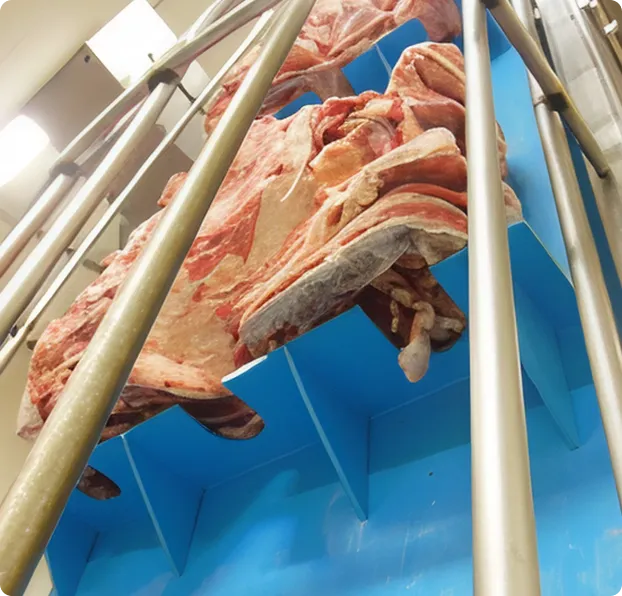
Pet food raw materials are commonly sourced from offcuts of various protein-rich materials such as meat and fish, often received in frozen form after being processed first for human food. Gusseted Volta belts can elevate heavy blocks into grinders without risking breakages that involve expense and downtime
Elevators after grinding or flaking
Volta belts on elevators and trough conveyors taking the broken-down blocks for further processing, reduce contamination on the belt and the conveyor. The non-stick or scrapable properties of the belt coupled with good containment prevent accumulation of dirt and its reintroduction to the product flow.
Handling of paste/chunks
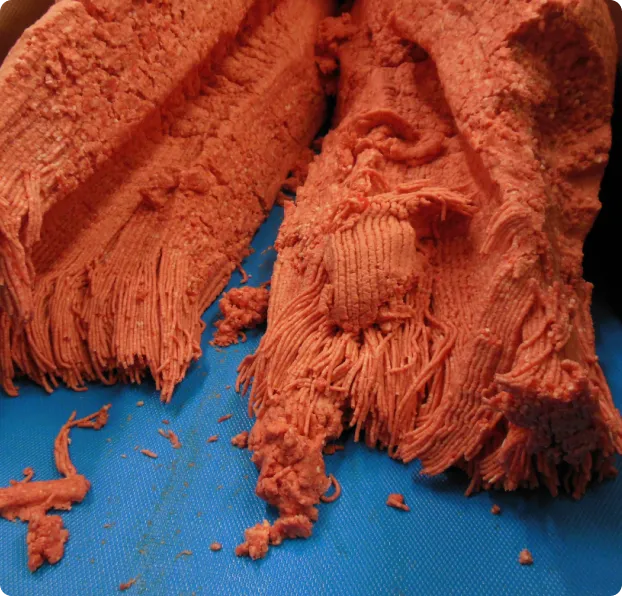
The uneven lumps of protein are further ground into a more homogeneous form or into chunks that can be cooked in sauces. Volta belts can be scraped without damage.
Canning, pouches or other aseptic packs
The material is cooked in its final form and, after cooling, is conveyed to various types of packaging machines each with a dedicated transfer system. Volta elevators are ideal for feeding multihead weighers and for canning lines Volta offers low friction profile belts with heavy duty reinforcement.
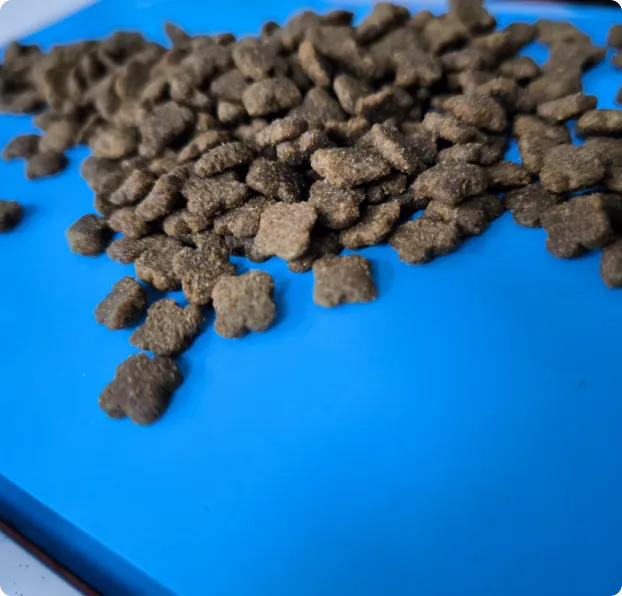
When developing and formulating dry pet food, manufacturers adhere to industry standards such as those set out by the Association of American Feed Control Officials (AAFCO) and the Nutritional Guidelines for Cats & Dogs by the European Pet Food Industry Association. These specify ingredients that meet all the animals’ nutritional needs. The most common way of making dry pet food is by extruding so-called ‘kibbles’ after blending ingredients into a dough and reducing humidity to around 10%. Here too, Volta belts excel and surpass industry standards.
Volta’s solid TPE belts are highly cut -resistant and can be installed easily onsite.
Volta’s belts offer a wide range of temperature resistance, from frozen to warm.
All Volta belts offer improved resistance to the complex chemistry of sprays applied to the kibble prior to being sealed in packages.
Improved cleanliness both from pathogens and foreign bodies reduces the possibility of product recalls.
Belt and conveyor washdowns are short and effective.
Frozen blocks
Pet food raw materials are often sourced from offcuts of various protein-rich materials such as meat and fish, received in frozen form after being processed first for human food. Gusseted Volta belts can handle blocks without risking breakages that involve expense and downtime. Blocks usually weigh 25kg or more and modular belts suffer from broken modules which require replacement and also trap food (dirt) particles. These blocks are then broken into coarsely ground pieces.
Handling of raw chunks and coarse grinding
Thes conveyors used after breaking down the frozen blocks and those incorporating fresh materials into the nutrient mix, suffer even more from contamination – correct use of Volta belts offers not just a cleaner conveying surface but also eliminates much of the contamination that would otherwise reach the conveyor.
Fine grinding
Volta belts offer both resistance and hygienic surfaces, even with grinding operations and handles the resulting ‘ice cream’ paste that is mixed, extruded and cooked prior to forming the kibbles. Cutting, FormingDuring the processes of extruding and drying, conveyors carry ribbons of product ending with cutting or molding operations, converting the material to a recognizable product. Volta fabrications help contain product and residue, transferring kibbles to the required elevation in a processing room with reduced energy output and reduced noise.
Cutting, Forming
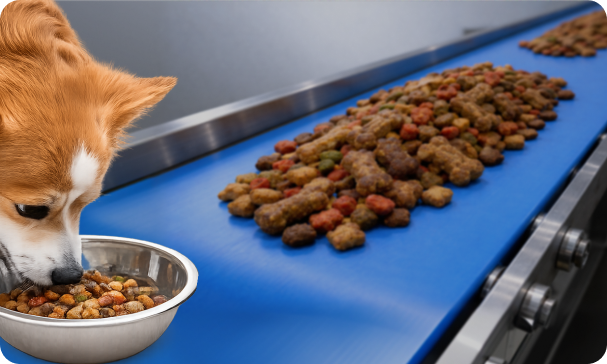
During the processes of extruding and drying, conveyors carry ribbons of product ending with cutting or molding operations, converting the material to a recognizable product. Volta fabrications help contain product and residue, transferring kibbles to the required elevation in a processing room with reduced energy output and reduced noise.
Drying
Volta belts cope perfectly with the varying humidity and residual particles.
Transfer of open kibbles to packaging
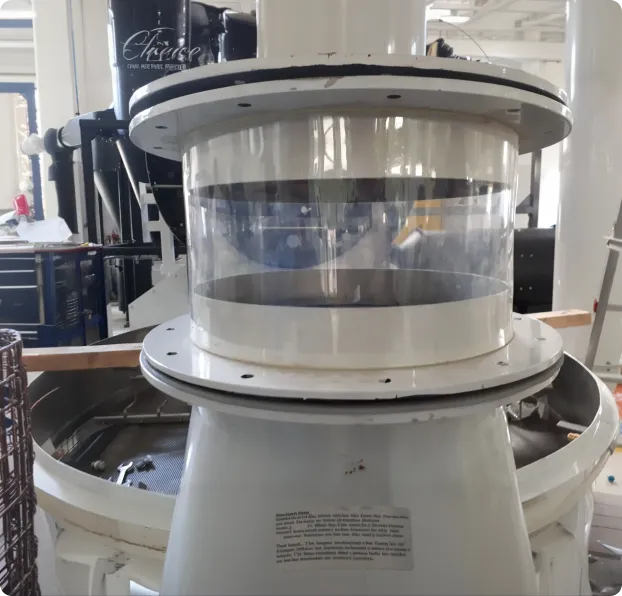
Volta has solutions for hygienic transfer of finished products including for heavy loads on retention conveyors and storeveyors.
Metal detectors
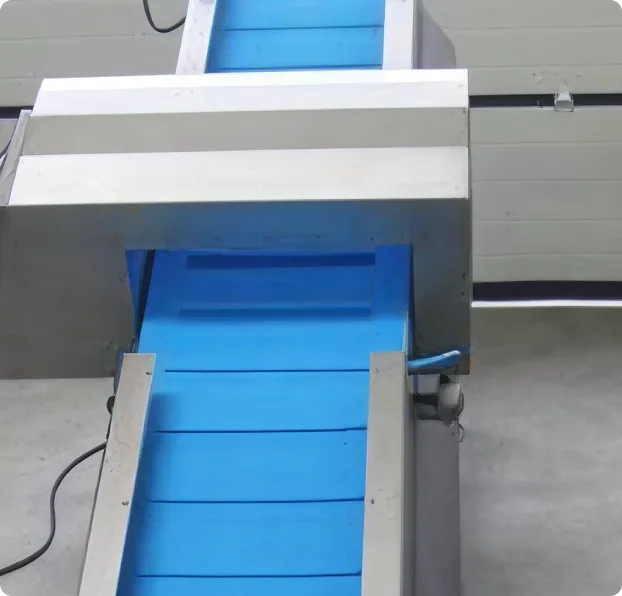
Volta offers homogenous belt options for metal detection and x-ray systems which are especially recommended where spillages can occur from open packaging.
Why Volta belts for pet food processing?
Volta homogeneous belts provide a smooth, non-porous belt surface that supports effective cleaning and helps reduce product buildup. Positive-drive options help improve tracking stability while minimizing tensioning requirements, and the homogeneous construction supports fast on-site installation and even repair, when needed. The result is a belt solution designed to help reduce sanitation downtime, simplify maintenance, and support continuously reliable conveying well-suited to pet food lines
The SuperDrive™ and DualDrive™ belts
These tough positive drive belts meet the most demanding challenges in the pet food processing industry.
- They are resistant to cuts caused by bone fragments and work in high impact applications, absorbing the shock that would fracture or rip other belts.
- Easy to clean surfaces keeps contamination risks in check, to better preserve product quality and keep belt odors to a minimum.
- Minimal tensioning required, the belts are easy to maintain with low belt wear and tear and low electric consumption.
SuperDrive™ and DualDrive™ belts clearly offer improved performance over modular belts.
Built to Meet the Highest Food Safety Standards
Our highly durable, moisture resistant belts comply with the strict hygiene requirements of the food industry, EU No.-10/2011, 1935/2004, 2023/2006 and relevant amendments. Complies with the Requirements of Code of Federal Regulations (CFR21) USDA FDA article 21 CFR 177.2600. Supports the HACCP concept.
FAQ’s
What makes a homogeneous belt a good fit for pet food processing?
A homogeneous belt has a smooth, continuous structure that supports easier cleaning and avoids joints or fabric layers that can trap residue. That makes it well suited to applications where hygiene and sanitation efficiency matter.
Are Volta belts suitable for both wet and dry pet food lines?
Yes. Volta’s pet food materials suit high risk zones as well as all other applications across wet processing, dry processing, packaging transfer, and inspection.
What is the difference between SuperDrive™ and DualDrive™?
SuperDrive™ is positioned for off-tracking control and extreme loads. DualDrive™ is a 2” pitch homogeneous positive-drive belt, making it a drop-in refit for 2″ hard to clean modular systems as well as being ideal forsituations where extra lateral strength is desirable.
Can the belts handle fats, oils, moisture, and abrasive products?
All areas where humidity whether from water- or oil-based materials is present, are by nature high risk zones and as such are both the best places to implement Volta and where Volta is the best choice.
Can belts be repaired onsite?
Yes. Volta’s materials are both easy to install on-site and can be repaired efficiently, thus reducing downtime.
Are compliance declarations available?
Yes. Volta’s website resources’ area contains declarations and certificates for relevant materials
Are there options for metal detection materials?
Yes. Volta offers metal-detectable belt options for applications where foreign-body control is important, especially around open product and packaging transfer.