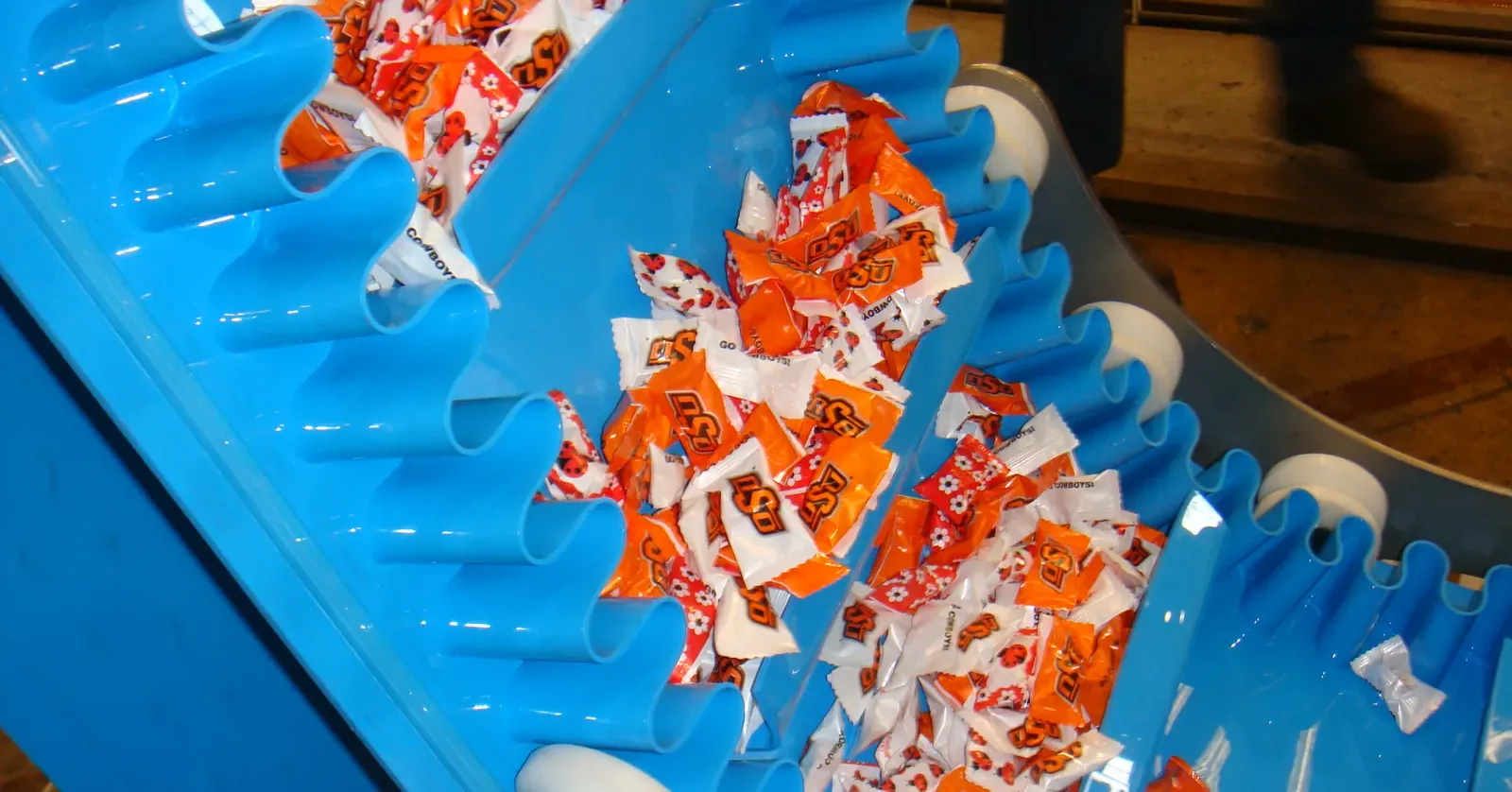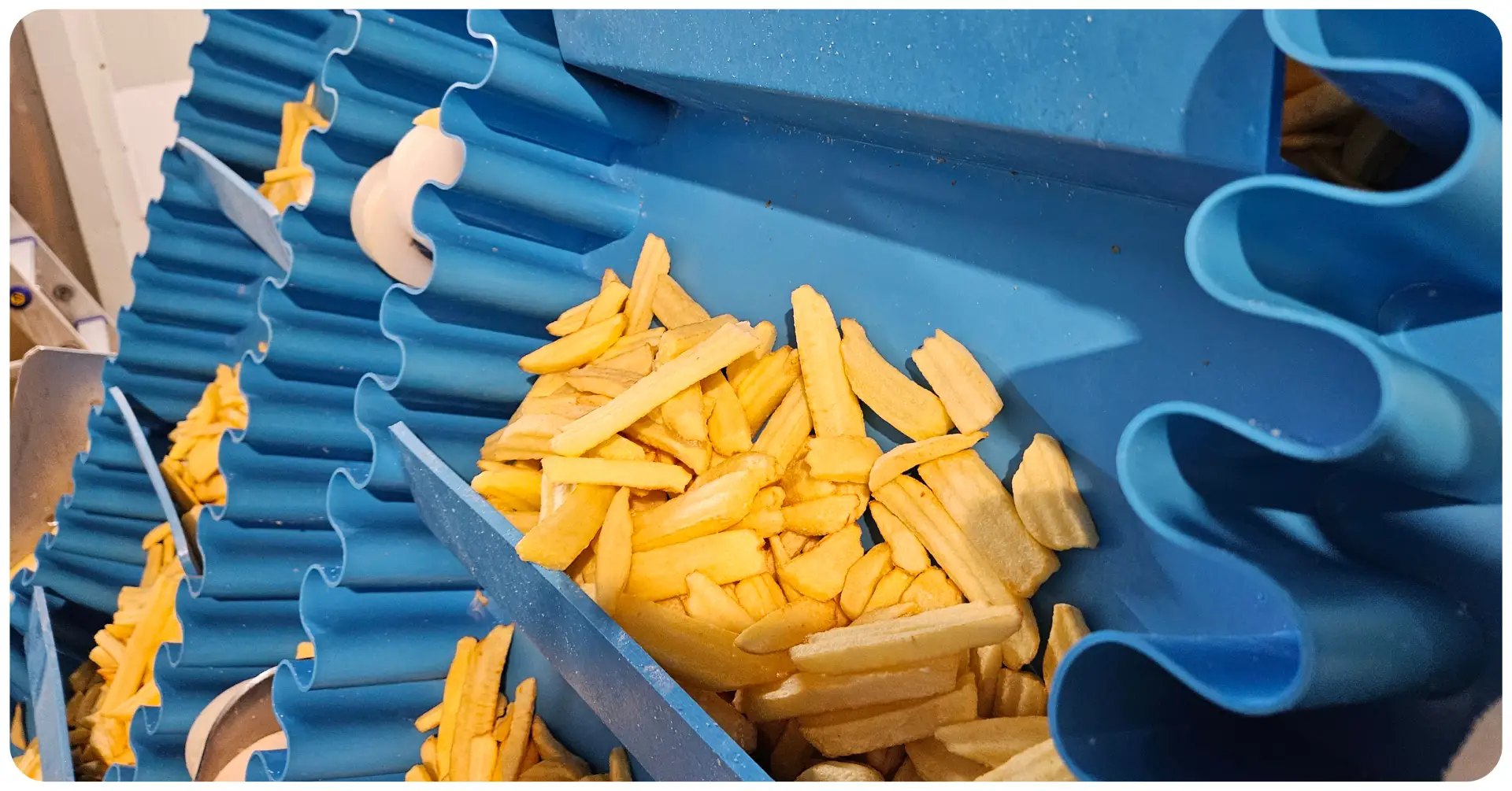
A hygienic conveyor belt is an open, certified food-contact belt engineered to prevent bacterial harboring in order to survive chemical washdown cycle. Standards include FDA, USDA, and various European directives including EC 1935/2004. They need to pass repeated auditing reviews, which are increasingly unified under international codes such as the GFSI where design standards such as EHEDG Guidelines are recognized benchmarks for conformity. The defining design principles are threefold: Cleanability, Accessibility, and Drainability. This involves eliminating areas along the belt path and close to it, where contamination accumulates. In terms of belts, no blind spots are allowed as found in modular systems and, for high-risk areas, no exposed fabric layers. Homogeneous, elastomeric belts conform to these goals as the manufacturing process is a continuous extrusion — bacteria have nowhere to penetrate, there being no layers or joints.
Aside from the base belt material, there are operational factors that contribute to a belt’s hygienic lifespan, including mechanical integrity (such as controlled tracking and no slippage), the ability to be disinfected in an efficient and cost-effective cycle, and the ability to resist chemicals to which it is exposed during various sanitation procedures. It is worth noting that one of the key cost advantages offered by homogeneous materials is the significant reduction in the need for chemicals, water, water temperature, and exposure time; we will discuss how this is implemented later. Belt and conveyor design go hand in hand. A belt that traps food residue and a conveyor design that permits residue to accumulate and then reenter the product flow are equally problematic. The sections below explain how to evaluate each of these dimensions before specifying a belt for a sanitary food environment.
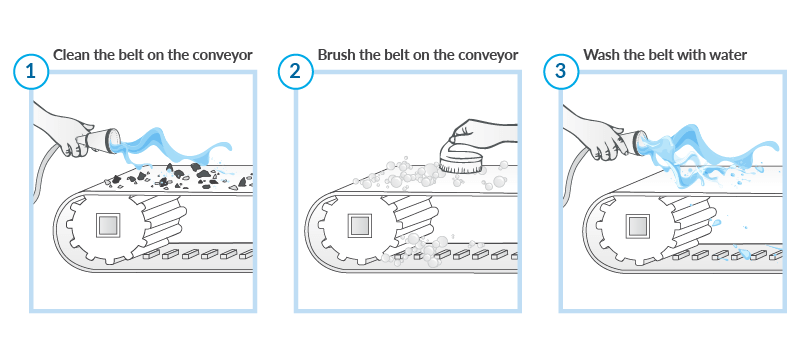
Why Belt Construction Is the Starting Point for Sanitation
Contamination can result from several sources: a priori design of the belt or conveyor; poor finishing of the materials and assembled belt conveyor unit; misuse or lack of proper maintenance in the processing facility, and (possibly avoidable) wear and tear. The belt or conveyor harbors the pathogen; the washdown can’t reach it; the product picks it up. This becomes more critical when we find a long working shift combined with a product that deteriorates over minutes or hours, leaving no time for intervening washdowns or sanitation. CIP was developed in part to answer this problem but raises problems such as the dispersal of contaminating material in an aerosol to neighbouring processes and workers. Auditors are well-trained in reviewing the common hygienic weak points: fabric-reinforced belts where wet washdowns are used, plastic modular belts where biofilm colonizes the hinge pins and contoured modules, and even some thermoplastic belts where hollow drive teeth are welded to convert them into cheap positive drive versions.
The solution to all these issues, in all high-risk areas, is a homogeneous belt — a belt extruded as a single piece of food-grade elastomeric polymer with no internal interfaces for liquid or bacteria to penetrate. Volta’s food-grade belts are built on this principle: one material, one cross-section, no layers, no woven core, and no modules. The team in charge of defining the standard of construction for a sanitary processing line should ask a single question when researching for the belt of choice: is it composed of more than one material or parts? If the answer is “no, there are none,” the belt has eliminated a primary cause of contamination and has rendered sanitation easier, faster, and more cost-efficient.
We pause here to discuss what ‘homogeneous’ means for a belt in the context of ‘high risk’ and ‘lower risk’. Apart from being extruded from a continuous elastomeric polymer as described above, there are several sub-categories of these belts. Ones with no other structural features are sometimes termed monolithic, and these are the main choice for high-risk areas {without going into details, ‘high risk’ means that the belt must be sanitized with water, whereas ‘lower risk’ areas are food-grade areas where no water or liquids are used to sanitize the belt}. There are three other options:
Welded teeth for positive drive. These are hollow, and this presents a threat as the weld weakens even slightly; capillary action will cause them to fill with water that cannot be flushed out. These are a design compromise and often feature in cheap belts.
Embedded aramid cords are used in some belts to allow soft materials to withstand greater forces. These are suitable for high risk but restrict the belt carrying power as they cannot be pretensioned beyond a few tenths of a percent. They are employed by some manufacturers as a way to try and strengthen weak elastomers.
Welded textile under the extrusion. Unique to Volta and suited to lower risk areas such as packaging lines or where no washdown is used (soap, powdered milk and some areas of biscuit lines)
The Standards That Define “Sanitary” in Practice
Saying a belt is “food grade” is a marketing claim. The pristine contact surface of a new coated fabric belt conforms to the required Standards. It may not last long and may fall foul of auditing after a short time, but it makes a project for a processing line cheaper. This is why it is crucial for ‘hygienic’ belts to be specified, not just ‘food grade’. The distinction here is understood inside the industry and implies a belt that is compatible with the level of risk assessed by QA even before the issue of designing a cleaning/sanitation protocol arises.EHEDG Guidelines and in particular Guideline 43 on conveyors and belts, outline the baseline for state-of-the-art Hygienic Design that offers direction for OEMs and food processors in designing correctly and in being able to defend both materially and legally from issues arising from contamination.
Several organisations have led the way for improving factory hygiene. The two key ones are EHEDG — the European Hygienic Engineering and Design Group and 3-a. Both publish guidelines on hygienic design for food safety, with EHEDG issuing Guidelines (as noted above) and a Handbook issued in 2017 which covers a huge range of topics as yet not tackled by guideline committees.
These organisations try to tackle the food safety issue from ‘farm to fork’ rather than imposing generic regulations such as the FDA, USDA, and EC requirements, and are adopted by the global organisations that have come together in benchmarking standards for design, production and auditing under the GFSI (Global Food Safety Initiative) that in turn draws its foundational scientific basis from the Codex Alimentarius. This hierarchy is working towards a system where all food processing units will be designed and will be operated under broadly similar conditions in the face of increasingly virulent and chemically-resistant strains of food pathogens.
Voltabelting materials hold a USDA Equipment Acceptance Certificate for meat and poultry processing and a separate one for dairy products, as well as EU certification (1935/2004/EC, 10/2011/EC, REACH, and certified testing as free of Bisphenol A and Phthalates).
For Halal-certified facilities, Volta’s belts also carry Halal certification.
Belt Material and Chemical Resistance Under Real Washdown Conditions
Passing a compliance audit at installation is not the same as remaining sanitary through three years of daily washdown. Classic fabric-based belts look pristine on day one, whereas in fact, under a microscope, the porous structure that will soon harbor bacteria is already evident. This microstructure becomes ever more macro with exposure to harsh cleaning agents, until cracks form and even delamination occurs. Processors have a duty to change these belts frequently to prevent pathogenic levels rising in product, and this belies the claim that cheap belts save money. Adding changeover costs by outside contractors and downtime, they soon become a poor investment as well as a risk.
Thermoplastic elastomers as belt material were pioneered by Volta and combine the hardness necessary to resist surface abrasion with the impervious nature of extrusions that give the chemical resistance required to survive the working conditions in almost all food contact applications.
A further aspect of hygienic belting is the additional fabricated accessories that are routinely attached to belts (up to 40% of all belts in some food processing sectors). The quality of the join between cleats or guides or welded side walling and the exact geometry of the join influences cleanability. As cleats are the most heavily of these elements subject to constant food contact, Volta cleats are welded with a specific radius as defined in various design manuals.
How Positive Drive Technology Changes the Sanitary Equation
Classic conveyor belts were designed on the principle of pretension, which involves stretching the belt over the pulleys in order to prevent the loaded belt from slipping. Slipping entails a failure to move the product and a devastating localized overheating of the belt.
The use of pretension has its own problems. It stretches the belt surface, rendering it more prone to damage; it fixes a radius into the belt structure when at rest and can cause cracking if the intervals between usage are extended. It places strain on both the shafts and the bearings, which impose a heavier maintenance footprint on every such conveyor; it can increase the power needed from a motor to pull the load, and in a wet ambient, the drive pulley might need rubber lagging or at least knurling on the drum (both of which decrease cleanability).
Volta’s Positive Drive / SuperDrive technology eliminates pretension or reduces the amount needed. The undersurface of the belt has extruded teeth that engage in a toothed drive pulley. This removes the mechanical stress that degrades the belt surface and reduces strain on the rotating elements of the conveyor. Super Drive is also self-tracking, which allows the conveyor to be designed without a tracking system that would also require sanitation and thus simplifies sanitation. The lightweight nature of the material (a 3mm thick belt is commonly sufficient to replace an 8mm thick modular belt) simplifies the conveyor structure by allowing for a more streamlined conveyor bed without extra struts and other elements to support the belt and load. Thus, the entire conveyor does not just save time in sanitation but is also rendered more cleanable and accessible and less prone to prevent efficient draining, thus ticking all three of the Hygienic Design principles – it also makes the fabrication of the conveyor cheaper.
To summarize, plant management, when commissioning a new line in particular (as well as a simple belt replacement), should take many other factors into account where a homogeneous belt can save. Washdown cycle time, total cleaning costs, a gain in free production time, cost of wastewater, reduced belt replacement and more. Belt price per square metre is not a guide to value or cost-efficiency.
Volta’s frozen-food cleaning case study is one of many site reports that show significant savings when thermoplastic belts are deployed in place of classic conveying solutions.
Matching the Belt to the Application: Food Segments and Their Sanitary Demands
As noted previously, not every sanitary belt requirement is the same, and the key division is high-risk and lower-risk. The actual belt specification is usually more a question of the conveyor geometry than the food type, and Volta has developed options to cope with the overwhelming majority of hygienic food applications, whether the conveyors are horizontal, troughed, elevators, centre-driven or use narrow, small pulley transfers.
Volta’s food-grade belts are specified across all food processing segments because the homogeneous PU construction addresses the baseline sanitary requirement — no internal harboring sites — and then the belt geometry and surface specification are matched to the specific line.
For production environments that include automated assembly, slicing lines, or enrobing, V & Round profile belts are good hygienic alternatives to other systems including wire mesh.
FAQ
What makes a conveyor belt "sanitary" for food production?
A hygienic conveyor belt must meet three criteria simultaneously: it must be made from food-contact-compliant materials; it must be finished with welding, mechanical joining, sealing, wiring, surface quality, and machining of all exposed parts to accepted standards. The overall composite structure of the unit must be cleanable, accessible for cleaning, and drainable. As far as plastic belting goes, only homogeneous thermoplastic extrusions provide these three requirements.
What is the difference between EHEDG guidelines and EHEDG certification?
EHEDG does not certify conveyors or belts to date – as explained, the overall assembly of so many diverse elements makes this impossible. Certain individual elements of conveyors, such as sensors, are certifiable. EHEDG publishes Hygienic Design and Engineering Guidelines and a Handbook. Specifiers looking to define their commission should require that Hygienic Design principles are applied and should specify hygienic and certified, homogeneous belts.
Can homogeneous belts be used in high-pressure washdown environments?
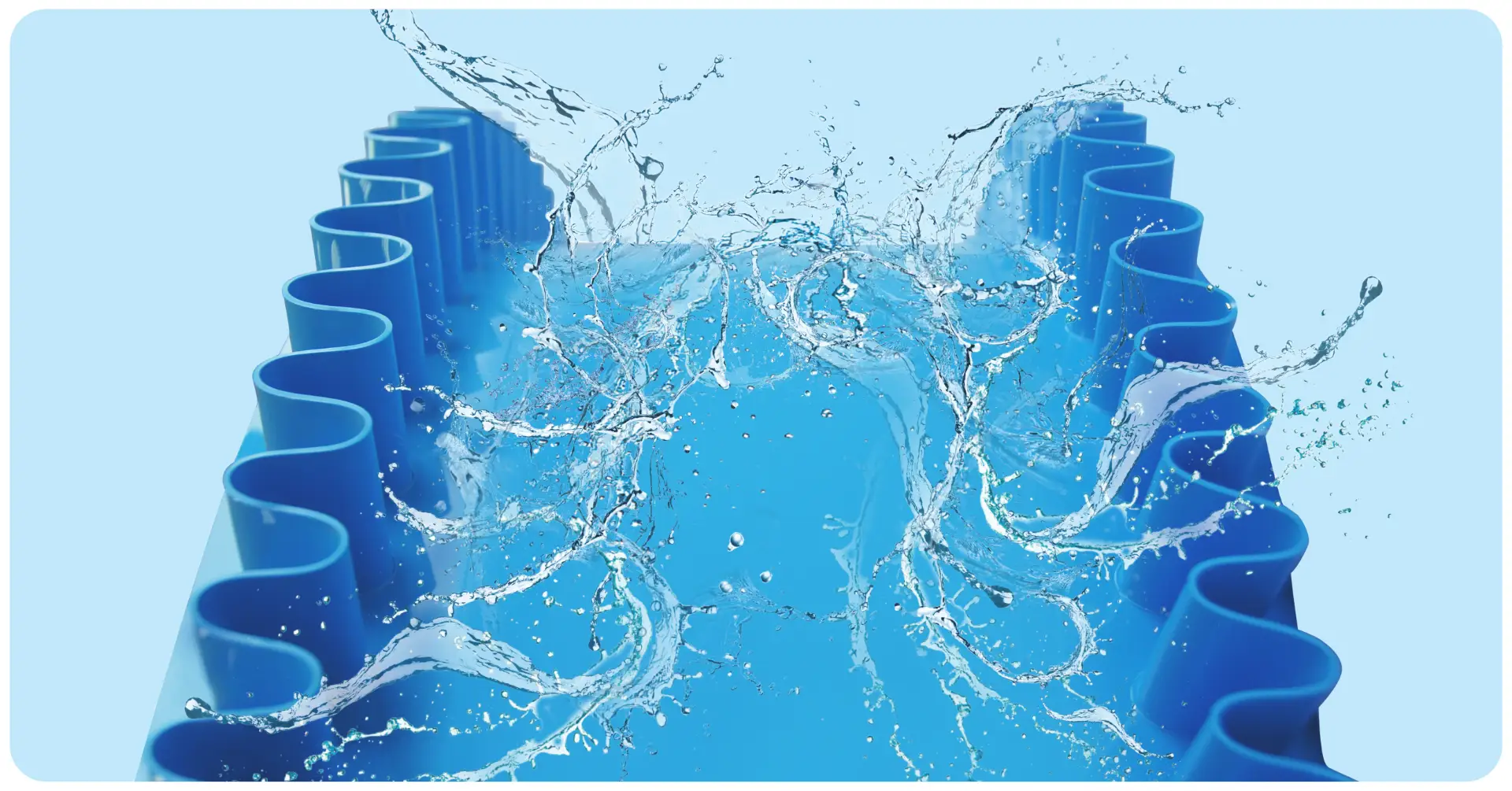
Yes. Homogeneous thermoplastic belts are specifically suited to high-pressure washdown because there are no adhesive bonds, no layer interfaces, and no woven cores to be damaged or penetrated by water.
Are homogeneous belts susceptible to chemical damage from cleaning agents?
The cleaning agents should be verified with Volta’s chemical resistance publications and recommended dosages should not be exceeded. As a rule, QA designs the sanitation protocol and has a duty to take the abilities and susceptibilities of the belt into account. Volta materials will generally require far less exposure time to chemicals and can usually utilize far cooler water to achieve the required disinfection. When applied, this saves both energy and protects the belt for an even longer lifespan. Many proprietary chemicals, oxidising and non-oxidising biocides, are compatible with food-grade elastomers.
What is the advantage of Positive Drive over conventional belt drive for sanitation?
As explained above, there are multiple advantages in using a positive drive belt that avoids heavy pretension. This protects both the belt and the mechanical integrity of rotating elements, as well as reducing electrical output and simplifying conveyor design. Positive Drive technology engages the belt directly, requiring zero pretension. Super Drive is the ‘go-to’ model for new conveyors in most applications, and a mini version (MiniSD) reduces the pulley size to 50mm making it an accessible technology for most food processing conveyors.
How often should a hygienic conveyor belt be replaced?
Belt replacement depends on operating conditions, adherence to the cleaning regimen, and belt type rather than calendar time. From a mechanical standpoint, it will typically last six to eight times longer than a fabric-reinforced belt and hygienically, almost infinitely longer in high-risk applications. Compared to modular belts, the mechanical lifespan is difficult to measure as modular belts can require substantial replacement of broken or worn modules over time – homogenous belts do not suffer this type of damage to the belt and also do not cause wear and tear to conveyor parts as modular belts do. The best indication of a hygienic need to replace a belt is when the ability to sanitize quickly falls off. A homogenous belt correctly used will pay its way in terms of total cost of ownership compared with any other plastic belt type, and this is the correct metric for belt procurement decisions in the modern age.
Are there sanitary belts suitable for both food and industrial applications?
Volta's industrial-grade belts address non-food applications; food-grade belts are specifically formulated and certified for direct food contact; there is no reason not to utilize their mechanical advantages elsewhere. In a hygienic context, belts are required in food processing, pet food processing, cosmetics such as soap, and biomedical and pharmaceutical applications. In other sectors, the advantage of the homogeneous belt systems is mainly to prevent failures, damage, and offer longer mechanical lifespan. It can save considerable costs but obviously does not require certification.
Specifying a sanitary conveyor belt correctly — construction, material, drive system, certification — is an engineering decision with real consequences for HACCP compliance, washdown cycle time, and total cost of ownership over the belt’s working life. Volta’s applications engineers have worked across meat, fish, bakery, dairy, and fresh produce lines in 60+ countries, and they bring that field experience to every belt specification. If you are evaluating belts for a new line, replacing an existing belt that is failing your sanitation audits, or reviewing a conveyor design before build, contact Volta’s technical team to work through the specification together.